
She continued to cry, harder, feebly dabbed her eyes with the handkerchief she had received, and declared painfully: "He is hurting my emotions!"

The question being silently telegraphed around the court room was: When did this happen? Wasn't this trial about Indrani murdering her daughter to prevent her from marrying Rahul Mukerjea, her husband Peter Mukerjea's son from his first marriage?

After the wedding, Sheena and Mekhail did not meet again. Four or five months later she met her death. Mekhail referred to their last meeting without overt emotion, clear-eyed.

The ripping off the lid, that Mekhail did, on the chain of episodes that lead up to his sister's murder, while condemning Indrani for her actions, for the first time, paradoxically, allowed a more human -- if flawed and complicated -- picture to emerge of Indrani, allegedly The Woman Who Killed Her Own Daughter and shocked a nation.

Her elfin face could be seen and once more after many days the victim of this murder had a face and a presence.
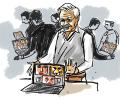
The software had, perhaps unknown to Dr Tripathi, tracked the changes he had made. The 'morph track' feature of the software provided a trail of what had been done and also indicated that the doctor had, it seemed, opted to morph Sheena's face with the provided skull, much in the same manner that Fantamorph can turn a woman into a cheetah.

Throughout, Mekhail spoke calmly, with hardly an inflection making even the barest attempt to hijack his tone. His tone was so empty it made his narrative all the more touching. And ugly and grey, as the monsoon sky beyond the window.

Then came the electrifying climax of Tuesday's hearing. Pasbola showed Sharma copies of cheques that had been deposited at the bank with Indrani's signature on them. He accused Sharma of forging Indrani's signature and collecting the money for herself. In the back Indrani stood up in the accused box and very pointedly nodded her head up and down and mouthed, "She did!".

One couldn't help feeling a certain melancholy viewing these now vagrant documents and photographs that would never be rightfully cherished. The pictures spoke to you. They offered slices of extinguished lives. They breathed sadness too, for what could have been and will never be. The sweet promises that Life made and insolently, arrogantly never kept.

'I returned to jail at 4.45. I was body searched and sent back to my cell.' 'A bowl of dal was kept there covered.' 'Another guard gave me a tablet and I became unconscious.' Accused One spoke about a similar incident happening to her in October 2015 and also with a bowl of dal.

Mekhail hopped off the bench in a hurry and turning his back to Indrani, stood at the window. Indrani ignored him too. Mekhail is getting married later this year. His mother will, of course, not be in attendance. Nor, of course, would he want her to be there, if she could.

'Indrani gave a mirthless laugh on spying The Suitcase, from the accused enclosure and, in sign language, gestured the impossibility of anyone fitting in such a small bag.'

Indrani called her personal assistant Kajal Sharma from the UK, May 3, 2012, and told her she had to sign Sheena's resignation letter as if she was Sheena signing it. But she had to first practice the signature and send Indrani proof of her proficiency in signing Sheena's name before sending the letter off. Sharma said she was reluctant and told the court that she told Indrani as much, but Indrani demanded it of her.

It is not often that Goswami's Nation-Wants-to-Know shows become material evidence in a murder trial no less. Nor was it something CBI Special Judge J C Jagdale was wildly enthused about. It had to be done because as he put it to CBI Special Public Prosecutor Kavita Patil caustically: "Your witnesses gave interviews to channels about a serious crime."

If Pasbola seemed like he was testing Rai on his high school physics, Rai on the other hand, had relocated himself to a classroom of philosophy, offering beautifully inexact answers, arrived at after deep thinking.

Pasbola wound up his cross examination, tabling a new narrative in the murder case. That Sheena Bora had been murdered not by her mother. But by her brother.

'As Rai spoke, in an unbelievably dead pan, almost off-the-cuff tone, about helping plan the murder of two youngsters, drugging them with vodka and whiskey spiked with dava (medicine), smothering one, dragging a body in rigor mortis out of a car, burning a corpse, destroying evidence, and so on, it felt like he was discussing nothing more surprising than the intricacies of the weather.'

as the trial proceeds, Peter is beginning to look more and more haggard while Indrani by contrast is blossoming. Khanna appeared exhausted and more down and out than usual at this hearing.

Why had the CBI decided to have Waghmare tell the court the tale surrounding this odd trip to Kolkata made for even odder reasons, close to a year-and-a-half after Sheena's murder? To show the kind of person Indrani was? And that the murder of her daughter was not a heat of the moment crime, given Indrani was capable of other odd, suspicious, premeditated acts like this?

Dramatic minutes like the sentencing by a judge or a round of artful cross examination hog all the attention in a courtroom. But more noteworthy and infinitely more memorable are the human moments -- Like when a brother and sister hug before a judge. Or the steady support between a husband and a wife in court.

Mekhail delivered the most deliberate heart-tugging line of the day: "If a son asks his mother for money is wrong, then tell me." At the back Indrani gave one of her most beaming smiles that was meant to convey the exact opposite. This was no mother happy that her son had said he turned to her when he needed money because she was his mother.
Vaihayasi Pande Daniel reports from the Sheena Bora murder trial.
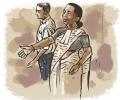
Ever since Mekhail had first entered the courtroom, he had, it would seem, never once looked at his mother, though they were a few metres away from each other. Curiosity, residual regard, memories, anger, none of it, could make him even look at the woman who gave birth to him. Was his hatred so overpowering?

Without a moment of hesitation, Rai jumped up on his rickety wooden stool in the witness box. He then drew his legs close to his body and wrapped his arms around his knees and finally tucked his head into his knees demonstrating the fetal position.

'With folded hands, on humanitarian grounds, if she can get temporary bail on medical grounds so she can get treatment.' 'If she dies, the whole trial gets derailed.'

'I kept photographs of everyone. Because I was working for them.' 'Madam, Saab...' Shyamvar Rai, the approver in the case, said in a tone that tried to suggest that that would be a routine practice for a driver.

Trepidation made its home firmly on his face on Thursday, announcing its presence with lines of anxiety and the repeated jumpy widening of his eyes.

Maruti Warke's basic understanding illustrated how far outside the system most less privileged Indians are -- simple, innocent people barely but admirably eking out an existence, with almost no knowledge of their surroundings or owning even the basic smarts to go about life. The same people who instinctively and often astutely vote governments into and out of office in New Delhi without knowing the entire reality of this country. The folks who are actually the essence of India.

That answer, the strangest of all till date in this courtroom, set off a ripple of excitement, surprise and muted amusement among those present, including Accused No 1 Indrani Mukerjea.

Shyamvar Pinturam Rai and Pradeep Waghmare. Both erstwhile employees of Peter and Indrani Mukerjea. In the witness stand on Monday, Waghmare came across as a cheerful, straightforward man who is attempting to clamber his way towards prosperity. In the witness stand on Friday, Rai shed his customary jauntiness and broke down weeping, begging forgiveness from CBI Special Judge Jayendra Chandrasen Jagdale.
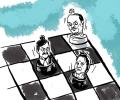
Sameer Buddha was just the kind of witness Indrani's lawyer Sudeep Pasbola dislikes. Someone, who had temporarily dumped his memory before entering the court. He answered most questions, one after another, one after another, one after another, with a monotonous, deadpan: 'I don't remember.' 'I don't remember.' 'I don't remember.'

When it came to his cross examination by Sanjeev Khanna's lawyer Niranjan Mundargi, Imtiaz Shaikh appeared to be afflicted by that peculiar gap-in-one's-memory or Choosy Memory Syndrome with his recall of other dates in his life, except those directly related with the murder, shaky or non-existent.

Tuesday was the last that Courtroom 51 saw of Shyamvar Rai, accused No 3 and approver in the Sheena Bora murder trial. True to form, Rai's final hours in the witness box were rather acrimonious. His cross-examination at several points turned downright ugly.

'I have strong reasons to believe that Accused number 4 (A4) Pratim Mukerjea with the assistance of other persons, including Accused no 3 (A3) turned approver Shyamwar Pinturam Rai may have conspired and abducted my daughter Sheena in 2012 and made her untraceable and subsequently destroyed evidence.'

There it lay, a photograph on the desk under a stapler, and later a stamp pad, forgotten, done with, like its subject, a Mumbai Metro One employee who vanished overnight.

In the 25 odd days that he has appeared before CBI Special Judge Jayendra Chandrasen Jagdale, you have experienced the entire range of emotions just observing him. Everything from pity to irritation. To bafflement. And shock. You have scoured his face, gazed into his eyes, watched his expressions and body language, searching vigilantly for motives. And come away no wiser. Who is Shyamvar Rai? Does anybody know?

'After Indrani's arrest did you go to the police and say I did this kind of forgery?'

Indrani was cheering Pasbola on from the back, with little, happy whoops, that she muffled with her chunni. Indrani was in her element on Friday. The defence's cross-examination was clearly going her way and Indrani was delighted.

Indrani, radiant in an immaculate white and gold salwar-kurta that matched the moment, her hair open, a bindi gleaming on her forehead, beamed placidly, fully enjoying this small minute of victory.

Finally to end the dispute, Sharma threatened to show her shoes. Pasbola declared regally that he would like to forgo that particular honour. Sharma ignored him. Instead, she bent down, took off her shoe and triumphantly held her prize aloft, and said delightedly, "Yeh dekhiye! (Have a look!)"

As he was giving evidence, Dr Matcheswalla peremptorily summoned the CBI representative over to the witness box and whispered something. Indrani Mukerjea's advocate Sudeep Pasbola immediately cut in, wondering what he was up to: "Please, please, please." Dr Matcheswalla, looking innocently startled, said: "I was asking if I can order for tea."
